

Brake system upgrade tips for 2026: 80% better stopping
Upgrading your vehicle’s brake system is one of the most impactful modifications you can make for safety and performance. Whether you’re a weekend track enthusiast or simply want more confident stopping power for daily driving, choosing the right brake components involves understanding material science, precision engineering, and modern technology trends. This guide walks you through a criteria-based approach to brake upgrades, helping you make informed decisions that match your vehicle’s needs and your driving style in 2026.
Table of Contents
- Understanding Brake Upgrade Criteria: What To Consider First
- Choosing The Right Brake Pads For Your Upgrade
- Leveraging CNC Machining For Superior Brake Components
- Comparing Modern Brake System Technologies And Modular Designs
- Practical Tips For Selecting And Installing Brake Upgrades
- Upgrade Your Brake System With Quality Parts From NordRace
Key takeaways
| Point | Details |
|---|---|
| Material selection matters | Sintered pads outperform organic options in heat resistance and durability for demanding use |
| Precision engineering is critical | CNC machining delivers micron-level tolerances essential for brake safety and performance |
| Modern systems offer advanced features | Digital brake-by-wire and modular designs enable better customization and automated driving support |
| Environmental impact varies | Brake pad composition affects wear debris toxicity and long-term ecological footprint |
| Installation requires care | Proper torque specs, bleeding procedures, and break-in protocols ensure upgrade success |
Understanding brake upgrade criteria: what to consider first
Before you order any parts, you need to understand what makes a brake upgrade successful. The difference between a transformative improvement and a disappointing waste of money often comes down to choosing components that match your specific needs.
Mechanical precision tops the list of critical factors. Tight tolerances and repeatability are essential for vehicle safety and performance, particularly in braking systems where even minor variations can affect stopping consistency. Modern manufacturing techniques have made it possible to achieve incredible precision, but not all brake components are created equal.
Material choice significantly impacts performance characteristics. Steel rotors handle heat differently than aluminum options, with steel offering superior thermal capacity for repeated hard stops while aluminum reduces unsprung weight. For calipers, the trade-off involves heat dissipation versus weight savings, a balance that varies depending on whether you’re building a lightweight track car or upgrading a daily driver.
Brake pad composition deserves special attention because it directly affects how your vehicle stops. Sintered pads use metallic particles fused under high pressure and temperature, creating a compound that resists fade under extreme heat. Organic pads rely on friction materials bonded with resins, offering quieter operation but less durability. The choice between these types should align with your driving habits and performance expectations.
Modern brake systems increasingly incorporate digital features and modular architectures. These designs allow for easier customization and maintenance, supporting everything from basic street upgrades to complex race applications. If you’re upgrading a newer vehicle, understanding how your chosen components integrate with existing electronic systems becomes essential.
Environmental considerations matter more than ever. Brake pad wear generates airborne particles containing various materials, some of which persist in the environment. Choosing lower-impact options when possible helps reduce your vehicle’s ecological footprint without necessarily compromising performance. For comprehensive vehicle optimization, consider how brake upgrades complement suspension tuning tips for balanced handling improvements.
Choosing the right brake pads for your upgrade
Brake pads represent the most accessible and impactful upgrade point for most enthusiasts. Understanding the differences between pad types helps you select components that deliver the performance characteristics you need.
Organic brake pads use friction materials like rubber, glass, and Kevlar bonded with high-temperature resins. They operate quietly, produce less dust, and generate smooth, progressive braking feel that many drivers prefer for street use. The main drawback involves faster wear rates and reduced performance under sustained hard braking, making them less suitable for track days or aggressive driving.
Semi-metallic pads blend organic materials with metal particles, typically 30 to 65 percent metallic content. This composition offers a middle ground between organic comfort and high-performance capability, handling heat better than pure organic pads while maintaining reasonable noise levels and rotor wear characteristics.
Sintered brake pads deliver the highest performance ceiling. Research confirms that sintered brake pads exhibit superior heat resistance, durability, and braking consistency compared to organic pads, making them the go-to choice for demanding applications. These pads maintain consistent friction coefficients across a wider temperature range, providing predictable stopping power whether cold or hot.
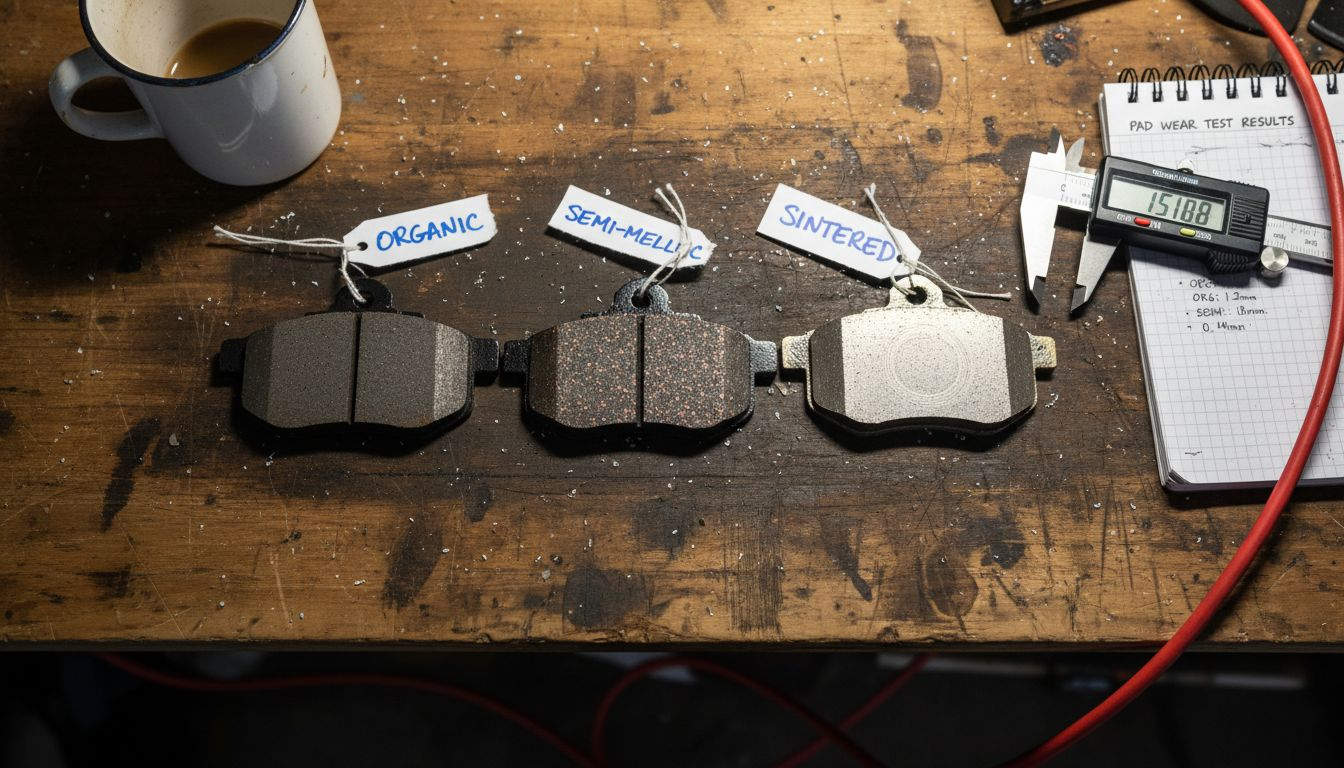
| Pad Type | Heat Tolerance | Wear Rate | Noise Level | Eco Impact |
|---|---|---|---|---|
| Organic | Moderate | High | Low | Lower |
| Semi-metallic | Good | Moderate | Moderate | Moderate |
| Sintered | Excellent | Low | High | Higher |
The performance differences become stark under demanding conditions. Sintered pads can handle temperatures exceeding 800°F without significant fade, while organic pads begin losing effectiveness around 500°F. For street driving with occasional spirited runs, semi-metallic pads often provide the best compromise.
Pro Tip: Match your pad choice to your hardest use case, not your typical driving. If you attend even one track day per year, sintered pads prevent the anxiety of brake fade during your most demanding moments, even if they’re slightly noisier during daily commutes.
Noise sensitivity matters for many drivers. Organic pads operate almost silently, while sintered options can produce noticeable squealing, particularly when cold. If you prioritize quiet operation for neighborhood driving, organic or semi-metallic pads make sense. Track-focused builds benefit from accepting some noise in exchange for uncompromising performance. Learn more about component selection philosophy through performance parts benefits to understand how brake choices fit into broader vehicle optimization.
Leveraging CNC machining for superior brake components
Manufacturing precision separates good brake components from exceptional ones. CNC machining technology has revolutionized brake part production, enabling tolerances and consistency impossible with traditional methods.
Modern CNC equipment produces brake rotors and calipers with micron-level precision. CNC machining delivers accurate fits, concentric bores, and balanced rotating components essential for brakes, steering, and driveline safety. This precision ensures that rotors spin true without wobble, calipers mount perfectly aligned, and pistons seal consistently across temperature ranges.
Weight reduction through strategic material removal represents another CNC advantage. Computer-controlled milling can create complex internal passages in calipers for better fluid flow or remove material from rotor hats to reduce unsprung weight without compromising structural integrity. For electric vehicles, every pound saved in rotating mass translates to improved range and efficiency.
The benefits extend beyond individual parts to complete system performance. Balanced rotors reduce vibration and stress on wheel bearings, while precisely machined caliper mounts ensure even pad wear and consistent brake feel. These improvements compound, creating noticeable differences in pedal feedback and stopping consistency.
Prototyping capabilities enabled by CNC technology allow manufacturers to iterate designs rapidly. Engineers can test multiple rotor vane patterns or caliper piston configurations, refining designs based on real-world testing. This iterative process produces brake components optimized for specific applications, from heavy trucks to lightweight sports cars.
“Precision manufacturing isn’t just about tight tolerances. It’s about repeatability, ensuring every component performs identically whether it’s the first or ten-thousandth unit produced. That consistency gives drivers confidence their brakes will perform predictably every time.”
Pro Tip: When comparing brake upgrades, ask about manufacturing methods. CNC-machined components justify higher prices through superior fit, balance, and longevity compared to cast or forged alternatives with minimal finish machining.
The quality differences become apparent during installation and use. CNC components typically require less fitting work, mounting smoothly with proper alignment. During operation, they produce less noise and vibration while delivering more consistent performance across their service life. For guidance on complementary upgrades, explore selecting car accessories to build a cohesive performance package.
Comparing modern brake system technologies and modular designs
Brake technology continues evolving rapidly, with digital integration and modular architectures reshaping what’s possible. Understanding these trends helps you choose upgrades that remain relevant as vehicles become more sophisticated.
Brake-by-wire systems replace traditional hydraulic connections between pedal and calipers with electronic signals and electrically-driven actuators. These systems enable features impossible with pure hydraulics, including variable brake force distribution, integration with stability control, and regenerative braking coordination in hybrids and EVs. While still emerging in mainstream vehicles, brake-by-wire represents the future direction of brake system design.
Modular brake architectures like the MK C2 system allow manufacturers and upgraders to customize brake performance by mixing and matching components. This approach reduces costs while enabling precise tuning for specific vehicle weights, performance targets, and feature requirements. You can upgrade individual modules as technology improves without replacing entire systems.
| System Type | Size/Weight | Cost | Performance | Upgrade Path |
|---|---|---|---|---|
| Hydraulic | Larger/Heavier | Lower | Proven | Component replacement |
| Electronic | Compact/Lighter | Higher | Advanced | Modular updates |
| Hybrid | Medium | Moderate | Balanced | Selective upgrades |
Automated driving capabilities demand brake systems with built-in redundancy for automated driving, optimal recuperation performance, and modular architecture to support varying automation levels. Even if you’re not planning autonomous features now, choosing upgrade components designed with these capabilities ensures future compatibility as vehicle technology advances.
Energy recuperation in electric vehicles requires brake systems that seamlessly blend regenerative and friction braking. Modern systems can recover up to 70 percent of braking energy under optimal conditions, significantly extending range. When upgrading brakes on an EV or hybrid, ensure your chosen components work harmoniously with regenerative systems rather than fighting them.
The implications for DIY upgraders vary. Traditional hydraulic upgrades remain straightforward for most enthusiasts with basic mechanical skills. Electronic systems require more specialized knowledge and diagnostic tools, potentially limiting DIY viability. However, modular designs can simplify certain upgrades by allowing component swaps without complete system overhauls. Consider how these technologies interact with overall vehicle dynamics through suspension tuning insights for balanced performance improvements.
Practical tips for selecting and installing brake upgrades
Successful brake upgrades require careful planning and precise execution. Follow this systematic approach to ensure your project delivers the performance improvements you expect.
-
Assess your needs honestly. Track days demand different components than spirited canyon drives or daily commuting. List your hardest use cases and choose parts rated for those conditions.
-
Research vehicle-specific fitment carefully. Verify that rotors, pads, and calipers are explicitly listed for your exact year, make, model, and trim. Brake system variations between trim levels can cause expensive mistakes.
-
Plan the complete system. Upgrading pads without matching rotors or improving front brakes while neglecting rears creates imbalances that can compromise safety and performance.
-
Budget for proper tools and supplies. You’ll need torque wrenches, brake fluid, bleeding equipment, and potentially specialty tools for caliper pistons. Cutting corners on tools risks improper installation.
-
Schedule adequate time. Rushing brake work invites mistakes. Plan a full day for a four-wheel upgrade, including bleeding and testing.
Installation demands attention to critical details. Clean all mounting surfaces thoroughly, removing rust and debris that could prevent proper seating. Apply anti-seize compound to caliper slide pins and mounting bolts, but never on rotor surfaces or pad backing plates. Torque all fasteners to manufacturer specifications using a calibrated torque wrench.
Brake fluid maintenance often gets overlooked during upgrades. Old fluid absorbs moisture, lowering its boiling point and risking vapor lock under hard braking. Flush the system completely with fresh fluid rated for your performance level. DOT 4 suits most street applications, while DOT 5.1 handles higher temperatures for performance use.
Break-in procedures prove critical for optimal performance. New pads and rotors need gentle bedding to transfer a thin layer of friction material onto the rotor surface. Follow manufacturer guidelines precisely, typically involving 10 to 15 moderate stops from highway speed without coming to a complete stop, followed by a cooling period.
Environmental responsibility matters during upgrades. Brake pad composition significantly impacts environmental impact through wear debris containing heavy metals and non-biodegradable materials. Choose low-copper or copper-free pads when possible to reduce water contamination. Recycle old rotors and pads through proper channels rather than discarding them.
Safety checks post-installation include verifying pedal feel, testing brake balance in an empty parking lot, and inspecting for leaks after the first drive. Listen for unusual noises and feel for vibrations that might indicate improper installation. If anything seems wrong, address it immediately before normal driving.
Pro Tip: Keep detailed records of your brake upgrade, including part numbers, installation dates, and torque specifications. This documentation proves invaluable for maintenance scheduling, troubleshooting, and future upgrades. Take photos during installation to reference correct routing and positioning.
For component selection guidance and quality parts, review car accessories selection guide to ensure your brake upgrades integrate well with other performance modifications.
Upgrade your brake system with quality parts from NordRace
Ready to transform your vehicle’s stopping power? NordRace offers carefully curated brake components from trusted manufacturers, ensuring you get genuine performance improvements without guesswork.
Our EBC Redstuff brake pads deliver low-dust ceramic performance ideal for daily drivers seeking better bite and cleaner wheels. For more aggressive applications, EBC Yellowstuff brake pads provide track-capable stopping power that still works beautifully on the street. These pads represent the sintered technology discussed earlier, offering heat resistance and consistency enthusiasts demand.
Brake upgrades work best as part of complete chassis improvements. Hardrace adjustable stabilizer links complement brake system enhancements by improving body control during hard stops, reducing weight transfer that can upset braking balance. Our experts can help you select components that work together harmoniously, creating measurable improvements in safety and performance. Contact us for personalized recommendations based on your specific vehicle and driving needs.
FAQ
What are the best brake pads for daily driving?
Organic or semi-metallic pads work best for most daily drivers, offering quiet operation and smooth feel without excessive dust. If your commute includes occasional spirited driving or you live in mountainous areas requiring frequent braking, consider semi-metallic pads for their improved heat handling. Save sintered pads for vehicles that see regular track use or very aggressive street driving.
How does CNC machining improve brake components?
CNC machining produces brake rotors and calipers with micron-level precision impossible through traditional manufacturing. This accuracy ensures perfectly balanced rotors that spin without wobble, precisely aligned caliper mounts, and consistent bore dimensions for reliable piston sealing. The result is better pedal feel, reduced vibration, more even pad wear, and longer component life compared to cast or minimally machined alternatives.
Can I install brake upgrades myself safely?
DIY brake installation is definitely achievable with proper tools, vehicle-specific instructions, and careful attention to detail. You must follow exact torque specifications, properly bleed the system to remove all air, and complete proper break-in procedures. However, if you lack mechanical experience or feel uncertain about any step, professional installation is worth the cost given the critical safety role brakes play. Never compromise on brake work quality.
How often should upgraded brake pads be replaced?
Replacement intervals depend heavily on pad type, driving style, and conditions. Sintered pads typically last 40,000 to 70,000 miles under normal street use, while organic pads might need replacement every 25,000 to 40,000 miles. Track use dramatically accelerates wear, potentially requiring replacement after just a few events. Inspect pads regularly and replace when material thickness reaches the minimum specified by the manufacturer, usually around 3mm remaining.
Do brake upgrades require larger wheels?
Not necessarily. Many brake upgrades fit within stock wheel dimensions, particularly pad and rotor upgrades that maintain stock caliper positions. Larger calipers or multi-piston setups often do require larger wheels for clearance, typically 17-inch minimum for most performance calipers. Always verify fitment with your existing wheels before purchasing, or budget for appropriate wheel upgrades if needed. Wheel sizing affects brake cooling and overall performance balance.